1
/
of
1
ARCO
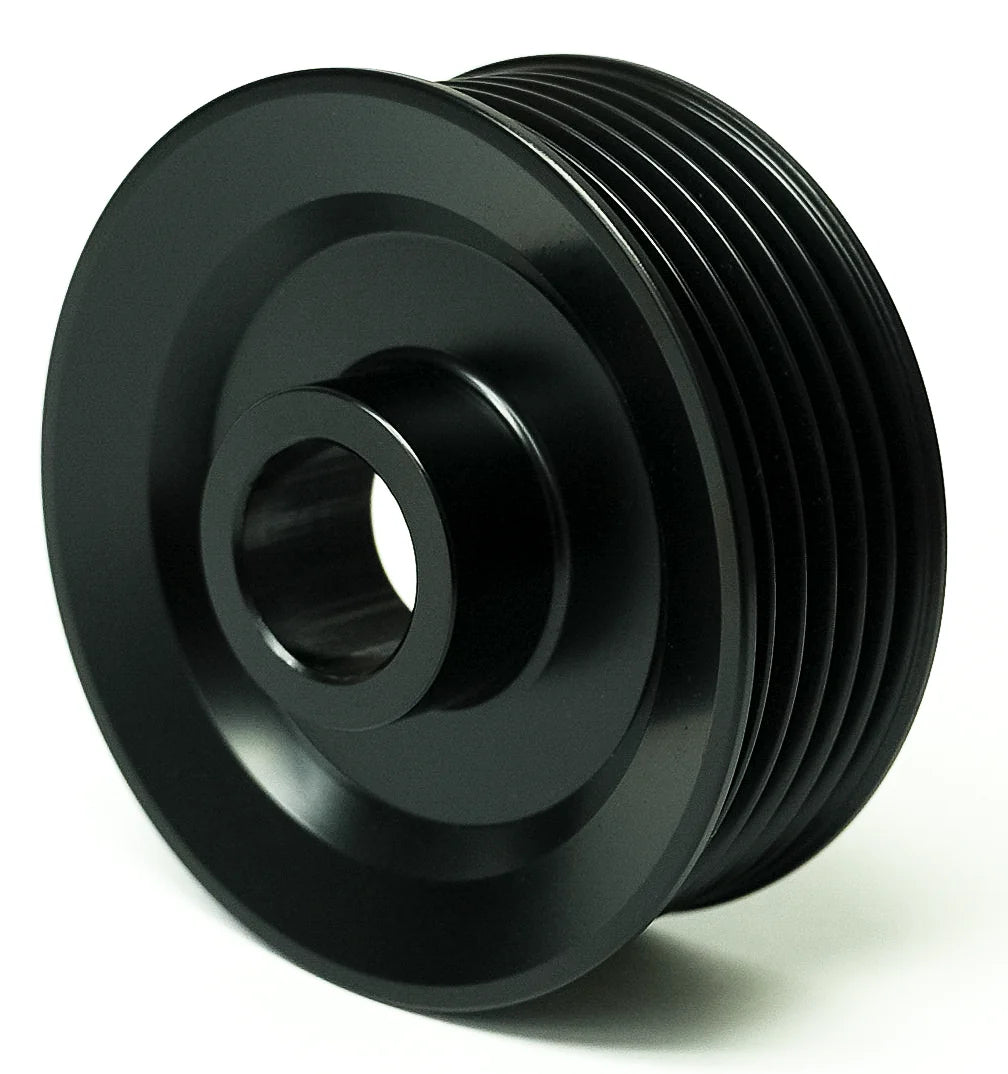
ARCO Pulleys
ARCO Pulleys
Regular price
$39.98 USD
Regular price
Sale price
$39.98 USD
Quantity
Couldn't load pickup availability
Pulley Type
OD (mm)
Bore (mm)
Grooves
Hub to Groove Center(s) (mm)
Notes
6G K Pulley
49
17
6-rib
—
Standard pulley
DV V-Belt Pulley
81
17
2 (3/8" or 1/2")
13.5 (1st), 30.5 (2nd)
Larger diameter dual-groove V-belt
DV V-Belt Pulley
71
17
2 (3/8" or 1/2")
22 (1st), 41 (2nd)
More offset dual-groove V-belt
6G K Pulley
60
17
6-rib
5.6 (1st groove)
Slightly larger than standard
6G K Pulley
64
17
6-rib
8.6 (1st groove)
Mid-size 6-rib
8G K Pulley
65
17
8-rib
8 (1st groove)
Higher output applications
10G J Pulley
53
17
10-rib (J)
—
Compact, high-rib density
The outer diameter (OD) of a pulley directly affects the rotational speed (RPM) of the alternator or accessory it drives. Here's how it works:
Basic Relationship:
Larger OD pulley → slower alternator RPM
Smaller OD pulley → faster alternator RPM
This is because the pulley acts as a gear: the engine crankshaft turns the belt, and the belt turns the alternator pulley. The ratio between the crankshaft pulley and the alternator pulley determines how fast the alternator spins.
Example:
If your engine crank pulley is 150 mm and your alternator pulley is:
50 mm → alternator spins 3× faster than the crank
75 mm → alternator spins 2× faster
⚠️ Why It Matters:
Too small a pulley: Alternator may overspeed at high engine RPMs, risking damage.
Too large a pulley: Alternator may undercharge at idle or low RPMs.
Here’s how different alternator pulley outer diameters (ODs) affect alternator RPM, assuming a crankshaft pulley OD of 150 mm and engine speed of 3000 RPM:
Alternator Pulley OD (mm)
Alternator RPM
49
9184
60
7500
64
7031
65
6923
71
6338
81
5556
Pulley Type
Belt Type
Groove Shape
Common Use
DV
Dual V-belts
Deep V
Marine, industrial, legacy systems
K
Serpentine (3.56 mm rib spacing)
Multi-rib
Automotive, marine, high-load
J
Serpentine (2.34 mm rib spacing)
Narrow multi-rib
Share